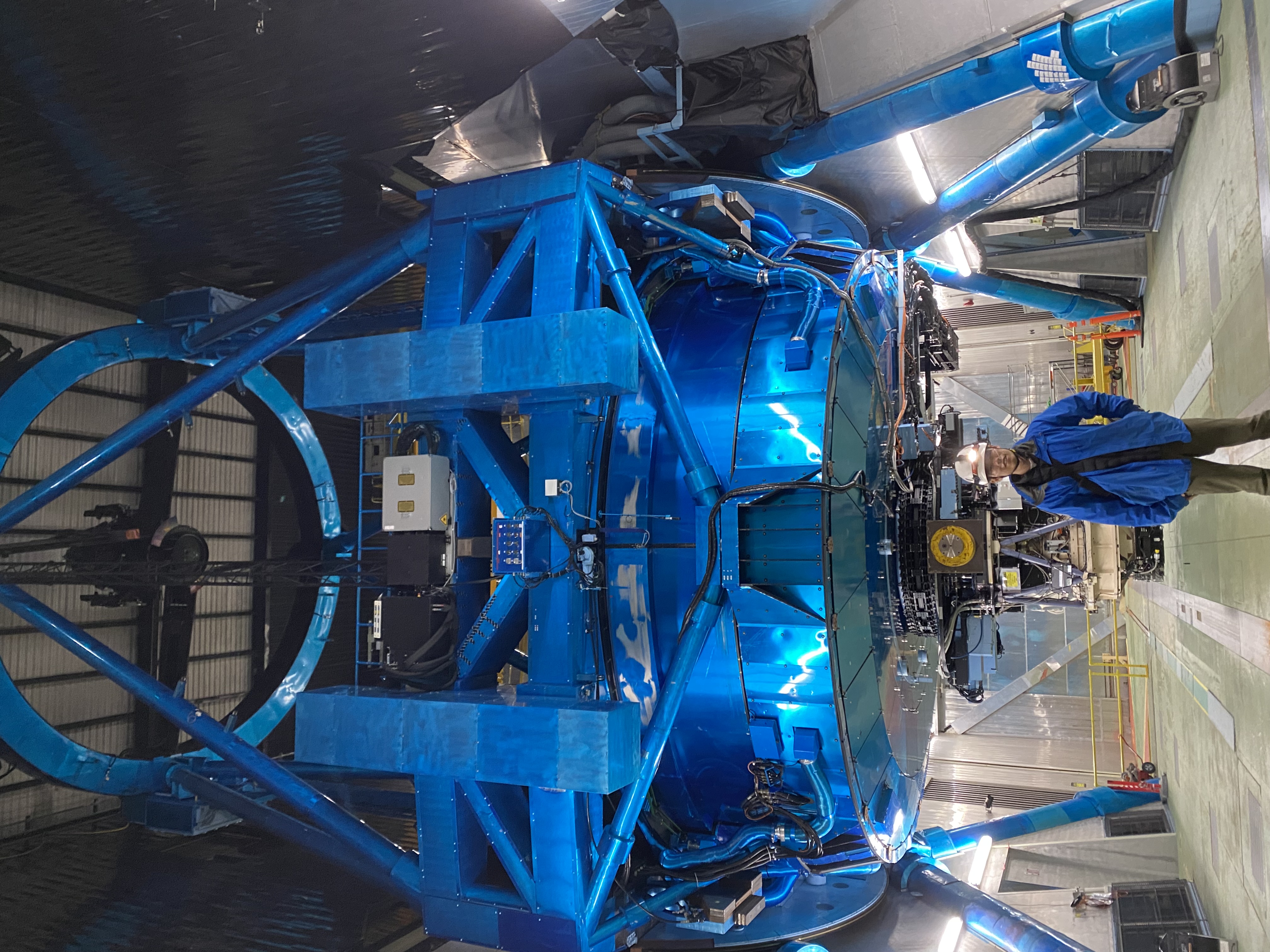
A research team including researchers from the National Astronomical Observatory of Japan and The University of Tokyo observed an occultation event, in which the trans-Neptunian object (612533) 2002 XV93 passed in front of a background star, from three locations in Japan including Kiso Observatory, and discovered the presence of an extremely thin atmosphere around the object. This is the first confirmed detection of an atmosphere around a trans-Neptunian object other than Pluto.
Mr. Hideto Yoshida (formerly Technical Specialist in the Department of Earth and Planetary Science, and currently Project Researcher at the Institute of Astronomy) has been awarded the Commendation for Science and Technology by the Minister of Education, Culture, Sports, Science and Technology (Outstanding Support for Research Award, Advanced Technical Support Category) for his “Technical Contributions to Earth and Planetary Sciences through Surface Analytical Instrumentation and Educational Material Development.”
Over many years in the Department of Earth and Planetary Science, he has made significant contributions to maintaining and managing analytical instruments, developing analytical methods, and fostering human resources, thereby supporting the research infrastructure.
A research team led by graduate student Akiyoshi Tsujita of the Department of Astronomy, Graduate School of Science, the University of Tokyo, used the Atacama Large Millimeter/submillimeter Array to observe a galaxy in the early Universe about 12.9 billion years ago and searched for fluorine. Despite deep observations, no signal was detected, providing a stringent upper limit on the fluorine abundance in the most distant Universe probed to date. This result challenges the conventional view that massive Wolf–Rayet stars were the dominant producers and suppliers of fluorine in the early Universe, and offers an important clue to the origin of fluorine and the physical processes inside stars.